
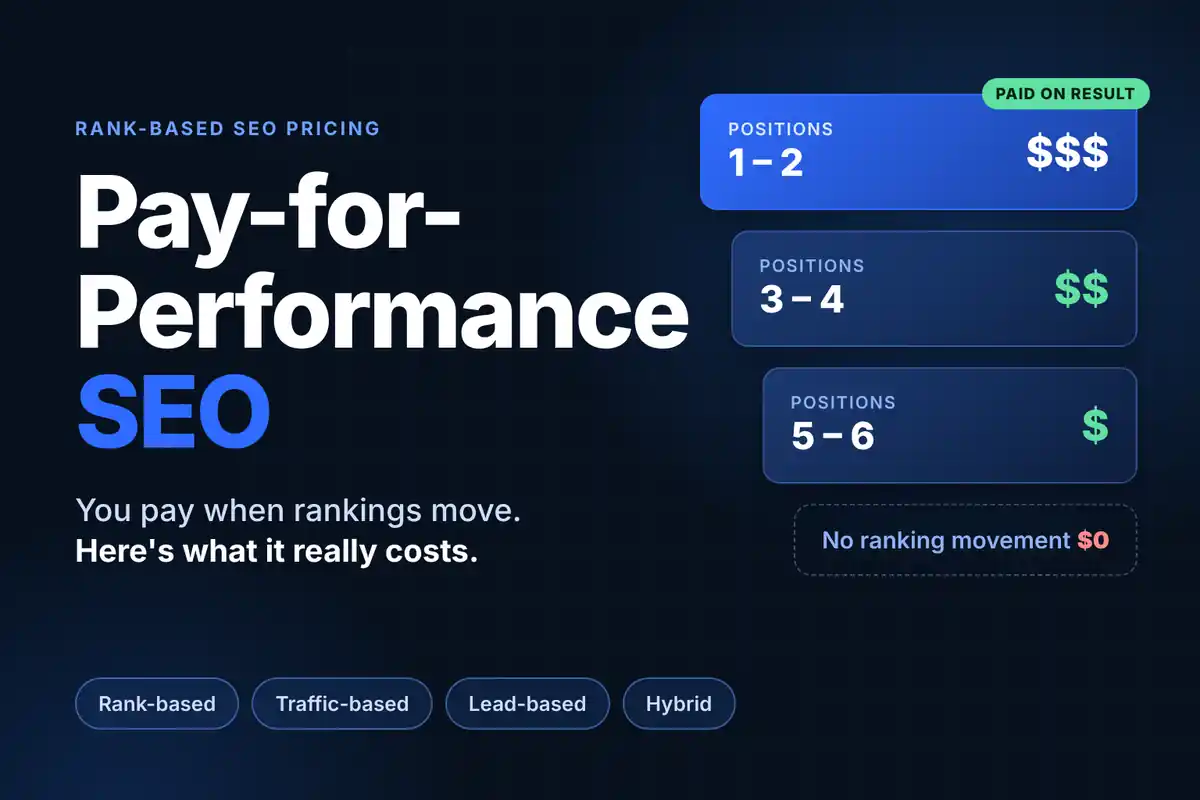
Pay-for-performance SEO is a pricing model where you pay only when agreed outcomes are achieved — usually a keyword reaching a set ranking position, a traffic increase over a baseline, or a qualified lead from organic search. If the outcome doesn’t happen, no fee is due for it.
That sounds like it removes all the risk from a channel that is notoriously hard to hold anyone accountable for. It removes some. It also introduces a different set of risks that are less obvious, and they come from the pricing structure itself rather than from any individual provider being dishonest.
Here is how the model works, what it costs, and the specific conditions under which it’s a reasonable choice.
How pay-for-performance SEO actually works
There are four common structures. Most providers use one, and the differences between them matter more than the shared “only pay for results” headline.
Rank-based pricing
The most widespread version. You choose target keywords, the provider works on them, and a fee falls due when a keyword reaches a defined position band. Higher positions cost more.
RankPay, one of the longer-established providers in this space, bills on the first of the month for any keyword that entered a paid ranking tier during the previous month, with separate pricing per search engine. The structure is straightforward: no movement into a tier, no invoice for that keyword.
Traffic-based pricing
Payment is tied to organic sessions above an agreed baseline — for example, a fee per additional thousand visitors per month. This avoids the worst of the keyword-selection problem described below, because total traffic is harder to game than a hand-picked keyword list. It introduces a different argument: what counts as the baseline, and who adjusts it for seasonality.
Lead-based pricing
You pay per qualified lead attributed to organic search. This is the closest thing to a genuine performance model, and the rarest, because it requires the provider to trust your lead qualification and both parties to agree on attribution before any money changes hands. Those are the two things that most often break down.
Base fee plus milestones
A hybrid. A reduced monthly fee covers the work, and milestone payments trigger on defined outcomes. Reported structures put the base in the region of a few hundred dollars a month with milestone payments considerably larger.
This is the most honest version of the model and the one most likely to produce good work, for a reason worth stating plainly: SEO requires months of effort before any outcome appears. A provider earning nothing during that period is under pressure to find the fastest possible route to an invoice, and the fastest route is rarely the one that helps you most.
What pay-for-performance SEO costs
Published figures vary widely, and most come from providers who sell the model. Treat them as indicative rather than authoritative, and expect your own quote to differ by industry and competition level.
| Structure | Typical published range | What triggers payment |
|---|---|---|
| Rank-based, positions 1–2 | ~$500–$550 per keyword | Keyword enters the top two |
| Rank-based, positions 3–4 | ~$400–$450 per keyword | Keyword enters positions 3–4 |
| Rank-based, positions 5–6 | ~$300–$350 per keyword | Keyword enters positions 5–6 |
| Traffic-based | From ~$650 for 100+ added visits | Sessions above agreed baseline |
| Base + milestone | ~$300–$800/mo base, plus $500–$2,000 per milestone | Defined milestone achieved |
| Traditional hourly (comparison) | ~$75–$100 per hour | Time worked |
Note the last row. Total spend under a performance model often lands close to what a retainer would have cost. What changes is the risk distribution and the timing, not usually the amount. Anyone selling the model as straightforwardly cheaper is selling, not explaining.
Who actually offers it
The model is a niche rather than an industry standard. Providers that publicly build their pricing around it include RankPay, which operates a rank-tier billing matrix; ResultFirst, which prices against keyword ranking improvements; and Selworthy, which markets a commission-style structure. Several general agencies will negotiate a performance component on request without advertising it.
Many agencies still prefer monthly retainers, and that is worth holding on to: if performance pricing were straightforwardly better for both sides, adoption would be higher than it is.
The incentive problem nobody mentions
This is the part that gets left out of most explanations, and it is easier to see if you have worked in paid media, because rank-based SEO pricing is a CPA model. You pay a fixed amount per conversion event. The conversion event happens to be a ranking position rather than a purchase.
Every known failure mode of CPA pricing therefore applies.
Keyword selection is the entire game
Under a CPA model, the party being paid optimizes for the cheapest available conversion. In paid media that shows up as brand-term harvesting and audience narrowing. In rank-based SEO it shows up in the keyword list.
A keyword with almost no competition and almost no search volume can be ranked quickly and invoiced quickly. A keyword that would actually generate enquiries takes months and may never land. Both produce the same line item. If the provider chooses or heavily influences the keyword list, the structure rewards the first kind.
The defense is simple: you pick the keywords, and you check the volume yourself before agreeing to any of them. A keyword you cannot find monthly search volume for is not a keyword worth paying a success fee on.
Attribution decides who gets paid
Traffic and lead-based structures need an agreed measurement method before the first invoice, not after. Rankings vary by location, device, personalization and the day you check. Organic sessions move for reasons unrelated to the provider’s work — a seasonal peak, a PR mention, a competitor’s site going down.
Agree in writing which tool is authoritative, at what location and device setting, on what schedule, and how the baseline is adjusted. Attribution disputes are the single most common reason these engagements end badly, and they are entirely preventable at the contract stage.
Short payment horizons pull toward short-term tactics
SEO that lasts — technical health, genuinely useful content, earned links — takes months to show. A provider paid only on outcomes carries the full cost of that delay. That pressure does not make anyone dishonest, but it does bias the work toward whatever ranks fastest, and some of what ranks fastest carries real risk to your site.
Google’s own guidance on hiring an SEO warns that deceptive content produced on your behalf can result in your site being removed from its index, and is explicit that you are responsible for what a provider does on your site. The penalty lands on you, not on them.
What Google actually says about ranking guarantees
Google addresses this directly in its Search Central documentation on hiring an SEO. Its position is unambiguous: “No one can guarantee a #1 ranking on Google.” The same page advises treating providers who guarantee rankings, claim a special relationship with Google, or offer priority submission as warning signs.
This does not make pay-for-performance SEO illegitimate. There is a real difference between a provider who says “you pay only if this ranking is achieved” and one who says “this ranking is guaranteed.” The first is a pricing structure with the risk on the provider. The second is a promise nobody can keep.
It’s a useful screening question. Ask a prospective provider whether they guarantee the outcome. The honest answer is no — they guarantee only that you won’t be billed for what doesn’t happen.
When pay-for-performance SEO makes sense
| Reasonable fit | Poor fit |
|---|---|
| Local or low-competition markets where ranking is achievable in a realistic timeframe | Competitive national or enterprise SERPs where nothing moves for six months |
| A defined, finite keyword set you have chosen and validated yourself | An open-ended list the provider controls |
| Testing whether organic search is viable before committing to a retainer | Long-term organic growth as a primary channel |
| Clean analytics and agreed attribution already in place | Unclear tracking, disputed baselines, no rank-tracking tool |
| A site with no history of penalties and something to protect | A site that cannot survive a penalty |
The pattern: the model works when the outcome is measurable, achievable and chosen by you. It breaks when any of those three is missing.
How to structure the agreement if you go ahead
- Choose the keywords yourself, and verify search volume for each one before signing. This single step neutralizes most of the incentive problem.
- Name the measurement tool, location and device settings in the contract, along with who checks and when.
- Require a payment window — a ranking held for 30 consecutive days, not touched once on a Tuesday.
- Get a written commitment on link acquisition method, and the right to audit the backlink profile.
- Keep ownership of everything: domain, hosting, analytics, Search Console, any content produced.
- Set a cap. Uncapped per-keyword success fees on a large list can exceed what a retainer would have cost.
- Agree an exit path that leaves the site intact, including removal of any links built on your behalf.
Key Takeaways
- Pay-for-performance SEO ties payment to outcomes — a ranking position, a traffic increase, or a lead — rather than to time worked.
- Four structures dominate: rank-based, traffic-based, lead-based, and a base fee plus milestones. The hybrid is generally the most workable.
- Published rank-based pricing runs roughly $300–$550 per keyword depending on the position achieved; hybrid models pair a base of roughly $300–$800 per month with milestone payments.
- Total cost frequently ends up close to a retainer. The model changes who carries the risk, not usually the amount.
- Rank-based pricing is a CPA model, so it carries CPA’s failure modes — the cheapest conversion gets optimized for, which here means low-value keywords.
- Google states plainly that no one can guarantee a #1 ranking, and holds site owners responsible for what a hired provider does.
- It fits low-competition markets, finite keyword sets you selected, and short validation projects. It fits long-term organic growth poorly.
Frequently Asked Questions
Is pay-for-performance SEO legitimate?
Yes, as a pricing structure. Paying only for achieved outcomes is a legitimate commercial arrangement used by established providers. What is not legitimate is guaranteeing a specific ranking — Google’s own documentation identifies that promise as a warning sign. The distinction is between where the risk sits and what is being promised.
How much does pay-for-performance SEO cost?
Published rank-based pricing runs roughly $300–$550 per keyword depending on the position reached. Traffic-based models start around $650 for a modest visit increase. Hybrid models typically pair a $300–$800 monthly base with milestone payments of $500–$2,000. Quotes vary substantially by competition level.
Is it cheaper than a monthly retainer?
Often not. Total spend under a performance model frequently lands close to retainer cost. What changes is timing and risk — you pay later and only on outcomes, but you may pay a premium for that protection. Compare total projected cost, not the headline structure.
What’s the biggest risk?
Keyword selection. A provider paid per ranking has an incentive to target terms that rank easily rather than terms that generate business. Choose the keywords yourself and verify search volume for each before agreeing. The secondary risk is aggressive link building that triggers a penalty on your site.
Can an SEO guarantee first-page rankings?
No. Google’s Search Central guidance states directly that no one can guarantee a #1 ranking, and advises finding another provider if one promises first place. Rankings depend on a private algorithm, competitor activity, and changes no provider controls. A pay-on-results structure is not the same as a guarantee.
Does it work for competitive industries?
Rarely well. In competitive national or enterprise SERPs, meaningful movement takes many months, so a provider earning nothing in the interim is either subsidizing you or looking for shortcuts. Performance pricing suits local markets, low-competition niches, and defined short-term projects.
What should be in the contract?
The keyword list with verified search volumes, the measurement tool and its location and device settings, a holding period before a ranking counts, link-building method and audit rights, full ownership of your own assets, a total fee cap, and an exit clause that leaves the site intact.