
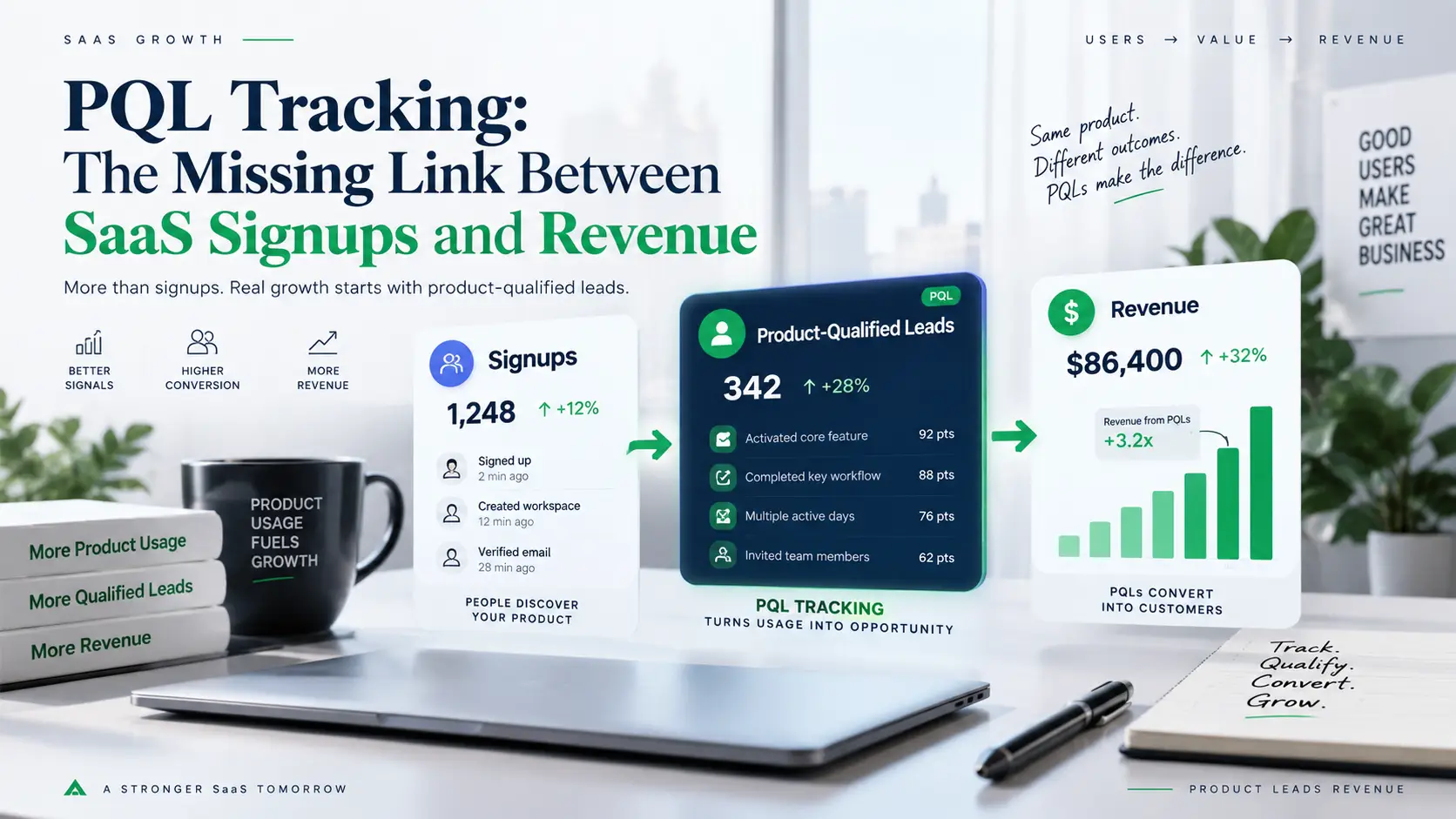
A signup is not the same as an activated user, a PQL or a customer. PQL tracking helps SaaS companies connect paid acquisition with actual product engagement and revenue.
For product-led SaaS companies, signup volume is one of the easiest metrics to collect.
It is also one of the easiest metrics to overvalue.
Someone creates an account. The advertising platform records a conversion. Marketing reports another signup.
But what happened next?
Did the user finish onboarding?
Did they use the core feature?
Did they invite a colleague?
Did they hit a usage threshold?
Did they become a product-qualified lead?
Did they ever pay?
Without those answers, the signup is only the beginning of the story.
What Is a PQL?
A Product-Qualified Lead is typically a user or account that has demonstrated meaningful product behaviour indicating a stronger likelihood of becoming a paying customer.
The exact definition varies by product.
For one SaaS company, a PQL may be a user who completes onboarding and connects an integration.
For another, it might be an account that:
- Invites three team members
- Uses a key feature multiple times
- Uploads a minimum amount of data
- Reaches a usage threshold
- Requests a higher-tier capability
The key point is that the qualification comes from actual product behaviour.
Why Signup Optimisation Can Go Wrong
Suppose two advertising campaigns generate the same number of signups.
Campaign A creates 200 signups, but only 8% activate.
Campaign B creates 120 signups, but 40% activate and a meaningful number become customers.
If your advertising platform sees only the initial signup, Campaign A may appear better.
That is exactly the problem.
The platform is optimising toward the easiest measurable event rather than the most valuable business event.
Separate the Funnel Signals
Instead of treating every action as one generic conversion, a stronger structure separates stages such as:
Signup
Activated User
PQL
Paid Customer
Each event can have different reporting and potentially different values.
This provides more useful information for both humans and bidding algorithms.
Marketing can see which campaigns create high-quality product users rather than simply more registrations.
Product-Led and Sales-Led Motions Need Different Signals
Many SaaS businesses operate both PLG and enterprise sales motions.
That introduces another layer of complexity.
A self-serve customer may move from signup to activation to payment without ever speaking to sales.
An enterprise buyer may request a demo and then go through qualification, security review, procurement and negotiation.
Those journeys should not be forced into one conversion structure.
The campaigns, budgets and success metrics may need to be separated.
PQL Tracking Improves Paid Acquisition Decisions
Once PQL data is available by campaign, keyword, audience and channel, the conversation changes.
Instead of asking:
“How many signups did paid generate?”
you can ask:
“Which campaigns generated users who actually behaved like future customers?”
That is a much stronger foundation for scaling paid acquisition.
Because a high-performing SaaS campaign is not the campaign that generates the most accounts.
It is the one that generates the right accounts.