
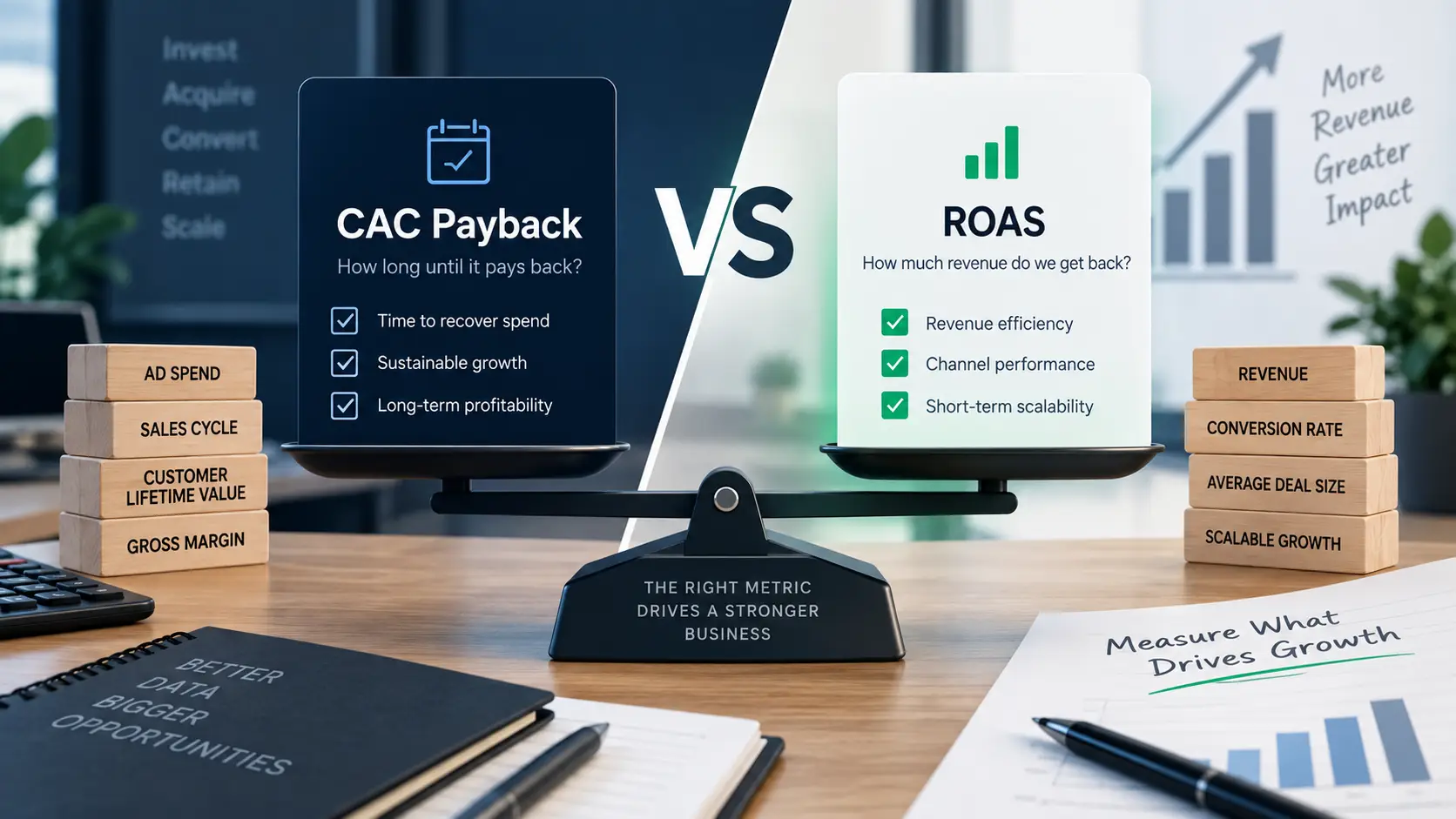
ROAS is useful, but SaaS companies often need a deeper measurement framework. CAC, CAC payback and pipeline performance can reveal whether paid growth is actually sustainable.
ROAS is one of the most popular metrics in performance marketing.
It is simple:
Revenue ÷ Advertising Spend = ROAS
Spend $10,000 and attribute $50,000 in revenue, and the reported ROAS is 5x.
For many businesses, that is useful.
For SaaS, it may not tell the entire story.
SaaS Revenue Arrives Over Time
Subscription businesses often acquire a customer today and earn revenue from that customer across many months or years.
That means campaign economics depend on more than immediate revenue.
Important variables include:
- Contract value
- Subscription length
- Gross margin
- Churn
- Sales cycle
- Expansion revenue
- Customer acquisition cost
A campaign with a lower initial ROAS may still be economically strong if it generates customers with high retention and strong lifetime value.
What Is CAC?
Customer Acquisition Cost measures how much it costs to acquire a customer.
At its simplest:
Total Acquisition Cost ÷ New Customers = CAC
Paid-media reporting can also look specifically at advertising CAC by campaign or channel.
For example:
If a campaign spends $50,000 and produces 20 new customers:
CAC = $2,500
Whether that is good or bad depends on the economics of the business.
What Is CAC Payback?
CAC payback measures how long it takes to recover the money spent acquiring a customer.
For SaaS teams, this can be more useful than looking at revenue in a single reporting period.
Two campaigns may produce customers at the same acquisition cost, but one campaign might attract accounts with significantly higher monthly or annual value.
Those customers repay their acquisition cost sooner.
Pipeline ROAS Can Be Useful Too
B2B SaaS companies with long sales cycles may not have enough closed revenue to judge recent campaigns immediately.
In that situation, pipeline ROAS becomes useful.
If $100,000 in paid media creates $1.5 million in qualified sales pipeline, that is a 15x pipeline ROAS.
However, pipeline is not revenue.
Close rate matters.
That is why reporting should ideally show multiple stages:
Spend → MQL → SQL → Opportunity → Pipeline → Customer → Revenue
There Is No Single Perfect Metric
A strong SaaS performance report does not force every question into ROAS.
It combines metrics depending on the decision being made.
For campaign optimisation:
- Cost per MQL
- Cost per SQL
- Cost per opportunity
For growth planning:
- CAC
- CAC payback
- Pipeline ROAS
- Revenue ROAS
For long-term economics:
- LTV
- Retention
- Expansion
Measure What the Business Actually Needs
Advertising platforms are good at telling you what happened inside the advertising platform.
Business decisions require more.
The final measurement framework should connect marketing activity with the financial outcomes the company actually cares about.
Because the goal is not simply a high ROAS number.
The goal is sustainable customer acquisition.