
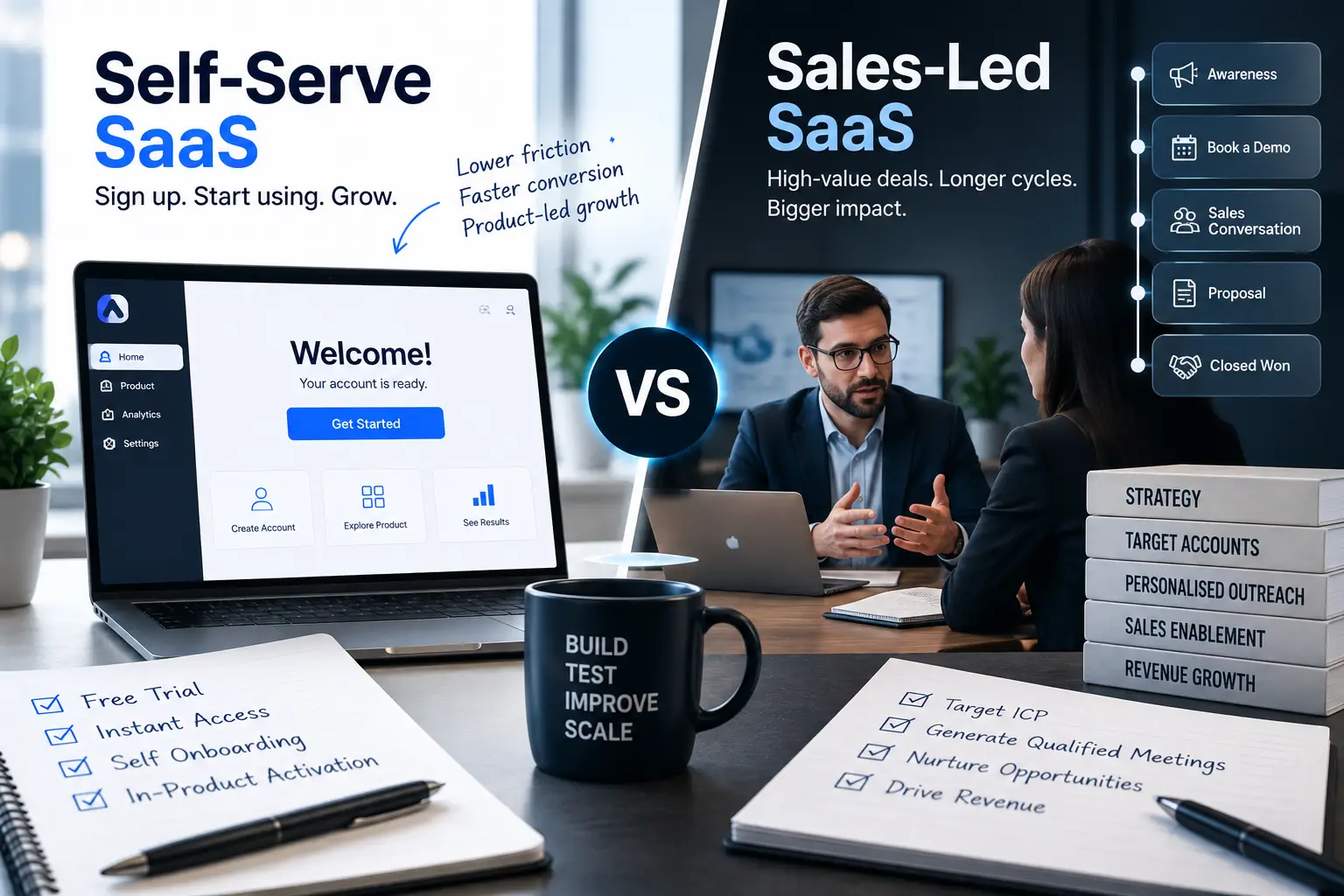
A low-cost self-serve signup and an enterprise demo request have completely different economics. Treating them as one conversion can quietly push ad spend toward the wrong customer.
Many SaaS companies now operate more than one growth motion.
A small business may discover the product, start a free trial, enter payment details and become a customer without speaking to anyone.
A larger organisation may request a demo, involve multiple stakeholders, complete a technical review, negotiate a contract and pass through procurement before becoming a customer.
Both buyers are valuable.
But they are not the same conversion.
The Economics Are Different
Consider these two outcomes:
Self-Serve Signup
- Lower acquisition cost
- Faster decision
- Lower contract value
- Product-driven conversion
Enterprise Demo
- Higher acquisition cost
- Longer sales cycle
- Higher contract value
- Sales-assisted conversion
If both actions are sent into Google Ads as the same conversion with the same value, automated bidding receives an incomplete signal.
The system will often favour the action it can generate most cheaply.
That can result in more self-serve signups while enterprise pipeline quietly declines.
Separate Campaign Objectives
A stronger paid acquisition structure may separate the two motions.
Self-serve campaigns can focus on:
- Signup
- Activation
- PQL
- Paid conversion
- CAC payback
Sales-led campaigns can focus on:
- Demo request
- MQL
- SQL
- Opportunity
- Pipeline
- Closed revenue
Each motion then has its own budget logic and optimisation target.
Landing Pages Should Reflect the Motion
The landing experience should also change.
A self-serve buyer may respond better to:
- Start Free Trial
- Create Account
- See Product in Action
An enterprise buyer may need:
- Book a Demo
- Talk to Sales
- Request Pricing
- Discuss Security or Compliance
Sending both audiences to the same generic page creates unnecessary friction.
Reporting Should Stay Separate Too
A blended dashboard can make strong performance look weak—or weak performance look strong.
If self-serve signups are inexpensive, they can dominate total conversion volume.
Meanwhile, the enterprise funnel may be producing fewer but much larger opportunities.
Separate reporting helps leadership understand:
- Which motion creates more pipeline
- Which produces faster payback
- Which has better retention
- Where additional budget should go
Hybrid SaaS Requires Better Measurement
There is nothing wrong with running self-serve and sales-led acquisition at the same time.
The mistake is pretending they have the same economics.
They represent different buyers, different journeys, different conversion signals and often different definitions of success.
Paid acquisition should reflect that reality.
When campaigns, measurement and budgets are separated correctly, the advertising platform stops chasing whichever conversion is easiest to generate.
Instead, each funnel can optimise toward the outcome it was actually built to produce.