
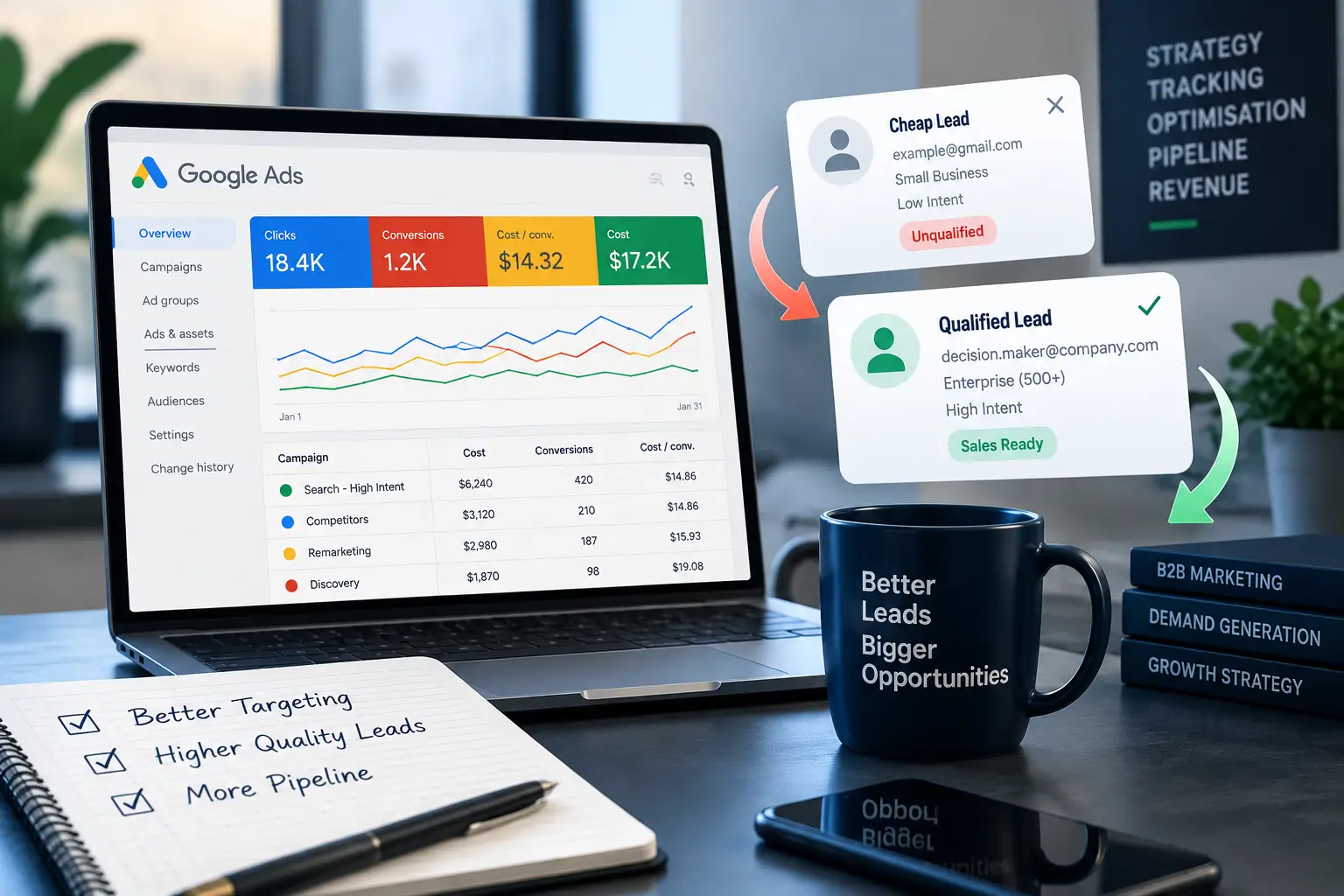
A low cost per lead can hide an expensive customer acquisition problem. B2B SaaS Google Ads should be optimised against qualified pipeline rather than the cheapest form submission.
One of the most misleading metrics in B2B SaaS advertising is cost per lead.
A campaign generates leads for less money, so it looks efficient. Budget increases. The dashboard improves.
Then sales starts asking why the leads are poor.
The problem is that Google Ads does not automatically know which lead is valuable to your business. It only understands the conversion signals you send back.
If the account tells Google that every signup or form submission has equal value, the system will optimise accordingly.
That often means finding more of the cheapest conversions rather than more of the conversions most likely to become customers.
Cheap Leads Can Become Expensive Customers
Imagine two campaigns.
Campaign A
- Cost per lead: $80
- 100 leads
- 2 customers
Campaign B
- Cost per lead: $180
- 50 leads
- 8 customers
Campaign A appears stronger if the dashboard stops at CPL.
But Campaign B is producing dramatically better commercial performance.
That is why B2B SaaS teams should look beyond basic conversion volume.
The more important metrics may include:
- Cost per MQL
- Cost per SQL
- Cost per opportunity
- Cost per customer
- Pipeline generated
- Closed revenue
- CAC
- CAC payback
Campaign Structure Should Reflect Intent
Not every search has the same commercial value.
Someone searching for:
“What is identity verification?”
is in a very different buying stage from someone searching:
“best identity verification software for fintech”
or:
“Company A vs Company B”
These searches should not necessarily compete for the same budget or be judged using the same target.
Strong B2B SaaS Google Ads structures often separate intent across:
- BOFU commercial terms
- Product/category terms
- Competitor campaigns
- Comparison searches
- Alternative-to searches
- Branded searches
- Research-oriented queries
This gives the account more control over where spend goes.
Search Term Hygiene Still Matters
Automation has made campaign management easier in some areas, but it has not removed the need to review what is actually triggering ads.
Performance Max, broad match and automated bidding can all create useful scale, but they can also introduce traffic from:
- Job seekers
- Students
- Existing customers
- Research searches
- Login-related queries
- Irrelevant adjacent industries
Regular search-term reviews and negative keyword management remain critical.
The platform should not be allowed to decide relevance completely on its own.
Connect Google Ads to the CRM
The strongest improvement for many SaaS accounts is not another bidding strategy.
It is sending better conversion data back to Google.
Instead of optimising only toward:
Form Submitted
you may eventually provide signals such as:
MQL Created
Opportunity Created
Customer Won
That gives automated bidding a clearer picture of what good demand looks like.
Optimise for Business Outcomes
The goal of Google Ads management is not to make the Google Ads dashboard look efficient.
The goal is to create profitable demand.
That requires understanding what happens after the click, after the signup and after the form submission.
The cheapest lead is not always the best lead.
The best campaign is the one that reliably creates customers at an acquisition cost the business can afford.