
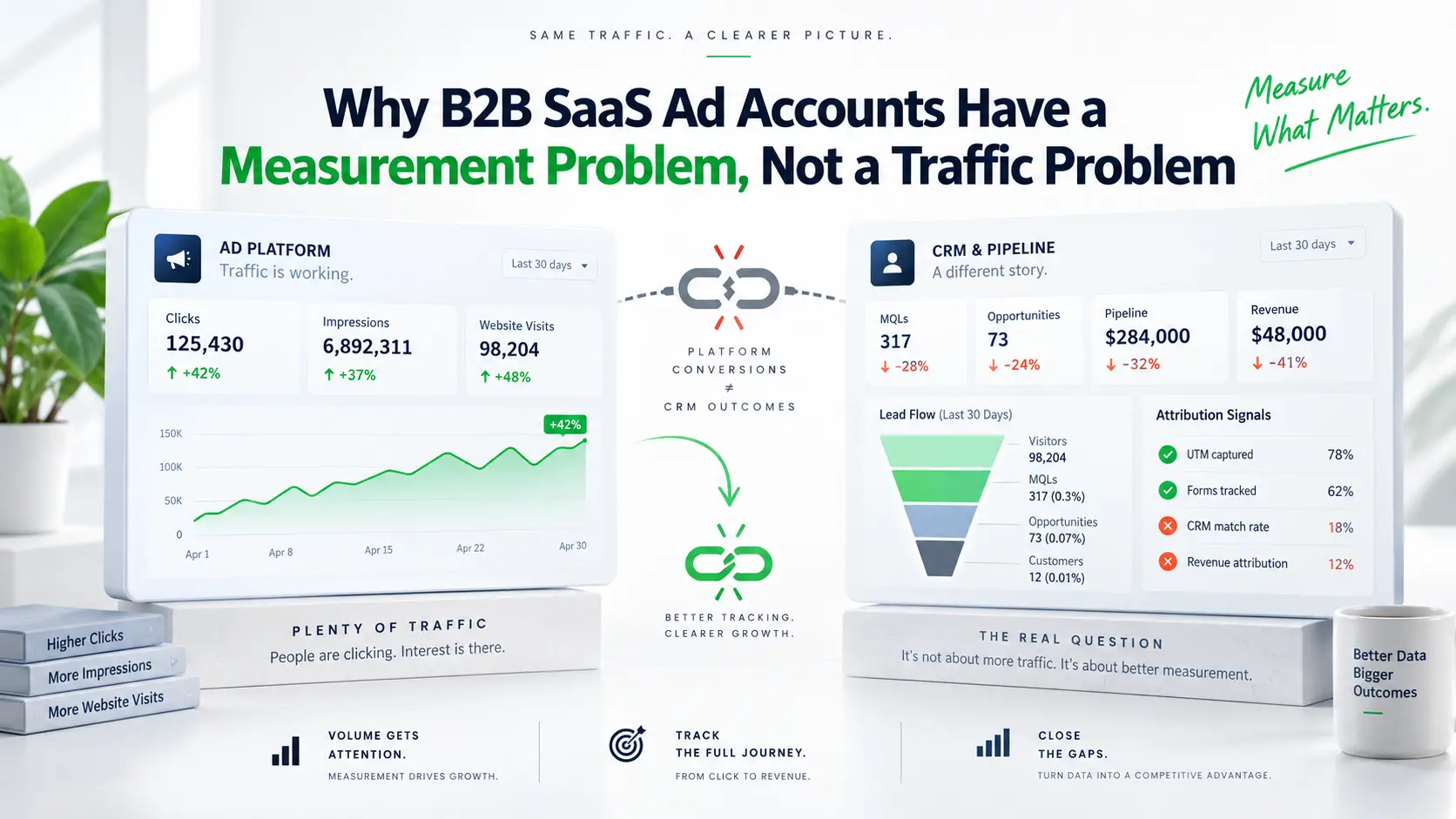
More traffic will not fix broken attribution. For B2B SaaS companies, the real challenge is connecting paid media activity with qualified pipeline, customers and closed revenue.Most B2B SaaS companies do not have a shortage of marketing data. They have too much of the wrong kind.
Google Ads reports conversions. LinkedIn reports leads. GA4 records events. Your CRM tracks contacts and opportunities. Sales has its own view of lead quality. Finance is looking at revenue.
The problem begins when those systems are telling different stories.
An ad platform may report 400 conversions while the CRM shows only 120 real contacts. A campaign may appear to have the lowest cost per lead while sales reports that almost none of those leads are qualified. A free trial signup may be counted with the same importance as an enterprise demo request even though the commercial value of those actions is completely different.
That is not primarily a traffic problem. It is a measurement problem.
Platform Conversions Are Only the Beginning
Advertising platforms are designed to optimise toward the signals you give them.
If every form submission, signup or trial is treated as an equally valuable conversion, the bidding system will naturally search for the cheapest way to generate more of them.
That can produce impressive-looking dashboards while pipeline quality gets worse.
For a B2B SaaS business, the real funnel may look more like:
Click → Signup → Activation → PQL → MQL → SQL → Opportunity → Customer
Each stage has a different value.
A signup that never activates should not carry the same weight as a product-qualified lead. A demo request rejected by sales should not be treated like an accepted opportunity. And a cheap lead is not actually cheap if almost none of those leads become customers.
Why CRM Data Matters
The CRM is where marketing performance becomes commercially meaningful.
Instead of asking:
- Which campaign generated the most conversions?
- Which keyword produced the cheapest leads?
- Which platform reported the highest ROAS?
A stronger measurement framework asks:
- Which campaigns created qualified opportunities?
- Which keywords resulted in customers?
- What is our cost per MQL?
- What is our cost per SQL?
- What is our cost per closed customer?
- How much pipeline did each advertising channel create?
This changes the way budgets are allocated.
A campaign with a higher cost per lead may deserve more budget if those leads move through the sales funnel at a significantly higher rate.
Sales Cycle Length Changes the Picture
B2B SaaS also has a timing problem.
Many accounts are judged using short conversion windows even when their actual sales cycle lasts 60, 90 or 120 days.
That creates a disconnect between the campaign being optimised today and the revenue that appears several months later.
Offline conversion imports and CRM integration help close that gap. Platforms can receive signals from deeper stages in the funnel rather than learning only from initial form submissions.
Fix Measurement Before Scaling
The natural reaction to weak performance is often to change the ads.
New creative. New landing pages. More channels. Different bidding.
Those changes can help, but not when the underlying measurement layer is unreliable.
Before increasing spend, reconcile the platform with the CRM. Separate conversion actions. Identify which events actually indicate commercial intent. Feed qualified and closed-won data back into the campaigns.
Once the measurement system is trustworthy, optimisation becomes far more useful.
Because the goal of performance marketing is not simply to generate more activity.
It is to know which activity becomes revenue.